


- Consumer Products
Back
Consumer Products
- Switches and Sockets
- Accessories
- Wires, Cables and Tapes
- Switchgear and Protection Devices
- PVC Conduits and Accessories
Back
PVC Conduits and Accessories

- Smart Homes and Buildings
Back
Smart Homes and Buildings
- Fans and Ventilation
- Water Heaters
- LED Lighting
- Solar
- Modular Kitchen
Back
Modular Kitchen

- Home Advancements
Back
Home Advancements

- Power Tools
Back
Power Tools
- EV Charger and Accessories
- Home Appliances
Back
Home Appliances
- Industrial Products
- Inspirations
- About Us
Back
About Us
- Our Story
Back
Our Story
- Manufacturing Excellence
Back
Manufacturing Excellence
- CSR
Back
CSR
- Careers
Back
Careers
- Our Story



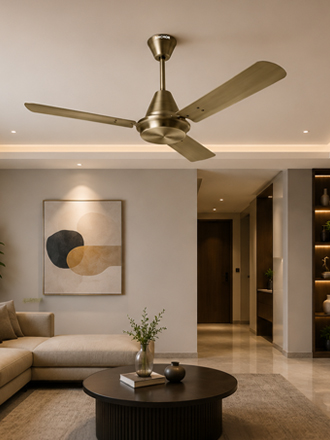


Difference Between Ceiling Fan and Table Fan: A Complete Comparison Guide

10 Min Read
During India's intense summer months, families naturally seek out effective ways to keep their living spaces comfortable without relying solely on air conditioners, which can drive up electricity bills significantly. Fans remain a staple in most households, but the difference between ceiling fan and table fan as well as table fan vs ceiling fan considerations often spark discussions when deciding between options that provide widespread cooling or more focused airflow.
A well-chosen ceiling fan circulates air throughout an entire room from its overhead position, while a table fan offers the flexibility of directing breeze exactly where someone sits or works. This detailed comparison draws on practical insights to help you understand their features, benefits, and ideal applications, empowering better choices for homes, offices, or even temporary setups.
What is a Ceiling Fan?
A ceiling fan mounts securely to the ceiling, using broad blades to circulate large air volumes downward for summer cooling or upward in winter to redistribute trapped warmth. Motors rated 50-100 watts create a wind-chill effect that lowers perceived temperature across entire rooms. Modern versions include remotes and timers for effortless control during family evenings. Professional installation ensures vibration-free, safe operation year-round.
What is a Table Fan?
A table fan stands on desks or tables, with compact oscillating blades delivering targeted breezes over short ranges via 30-60 watt motors. Users adjust heights, speeds, and directions for personal comfort during work or rest. Portability allows easy movement between rooms or outdoor spots like balconies. Simple plug-in setup and routine dusting maintain peak efficiency through humid seasons.
Ceiling Fan vs Table Fan Comparison
When exploring the difference between ceiling fan and table fan, practical factors like room size, energy use, and ease of movement come into focus, helping families weigh permanent installations against portable solutions. The table fan vs ceiling fan choice often hinges on how air gets distributed and the lifestyle it supports.
This table highlights key contrasts drawn from everyday experiences.
Aspect | Warm LED Light | Cool LED Light |
|---|---|---|
Air Delivery | Circulates across entire rooms early | Direct focused breeze to specific spots |
Effective Coverage | Up to 400 square feet | Personal area within 10-20 feet |
Energy Consumption | 50-100 watts for broad effect | 30-60 watts for targeted cooling |
Mobility | Stationary after fixed mounting | Easily relocated anywhere |
Operation Noise | Minimal at normal speeds | Noticeable at higher settings |
Upfront Investment | Rs. 2000-8000 including installation | Rs. 800-3000, ready to use immediately |
How to Choose the Right Size of Ceiling Fan?
Determining the correct ceiling fan size involves measuring your room's dimensions and considering ceiling height to achieve balanced airflow that cools effectively without straining the motor. Larger blades move more air but suit bigger spaces only.
- For cozy bedrooms under 100 square feet, a 48-inch sweep provides sufficient gentle circulation that lulls occupants to sleep comfortably.
- Living rooms spanning 100 to 150 square feet benefit from 52- to 56-inch models, ensuring family members feel the refreshing breeze from various seating positions.
- Expansive halls over 150 square feet require 60-inch or larger diameters to combat stagnant hot pockets near walls or corners.
- In rooms with ceilings taller than 10 feet, adding a downrod brings blades closer to head level, optimizing the downward push of cooler air.
How to Choose the Right Table Fan?
Selecting an appropriate table fan requires attention to blade size, oscillation range, and build durability to deliver reliable personal cooling suited to desks, kitchens, or bedside tables. Sturdy construction ensures stability during extended use.
- Compact 12- to 16-inch blades excel on office desks, generating powerful drafts for one or two people without occupying much space.
- Slightly bigger 18- to 20-inch versions serve small groups in kitchens, sweeping air across cooking areas to ease summer discomfort.
- Models with three or more speeds, plus timers, allow precise control for overnight operation or focused reading sessions.
- Prioritize fans with robust bases and protective grills, especially in homes with children who might bump into them accidentally.
When to Choose Ceiling Fan vs a Table Fan?
Navigating ceiling fan versus table fan decisions calls for evaluating permanent living arrangements against flexible, on-the-go needs common in Indian households juggling work, guests, and seasonal shifts. Fixed setups prioritize efficiency, while movable ones emphasize adaptability.
- Families settling into long-term homes favor ceiling fans for main living rooms and bedrooms, where steady room-wide cooling reduces reliance on costlier alternatives during peak summer heat.
- Renters or those with guest rooms turn to table fans for effortless relocation, positioning them near beds or study tables as visitors arrive without permanent alterations.
- Multi-functional open halls gain from pairing both types, letting the ceiling fan handle baseline circulation while a table fan supplements directed relief during intense afternoon warmth.
- Seasonal outdoor patios or storage-limited apartments lean toward table fans, which pack away neatly post-monsoon without installation commitments.
Conclusion
Ultimately, both ceiling fan and table fan options bring valuable relief tailored to distinct scenarios, with the difference between ceiling fan and table fan pointing toward comprehensive home cooling plans rather than one-size-fits-all picks. Larger, stationary areas thrive under ceiling fans for their broad efficiency and aesthetic appeal, whereas dynamic personal spaces call for the versatility of table fans.
Thoughtfully blending them often yields the best results, adapting to evolving family needs while keeping energy costs in check.
FAQs
What is the basic difference between a ceiling fan and a Table Fan?
Ceiling fans provide overhead, room-encompassing air movement, contrasting with table fans that offer portable, spot-specific breezes. This core table fan vs ceiling fan distinction shapes their everyday roles.
Which is better for overall room cooling: ceiling fan or Table Fan?
A ceiling fan excels at cooling entire rooms uniformly by pushing air downward effectively.
When should I choose a ceiling fan instead of a Table Fan?
Reach for a ceiling fan in dedicated living spaces requiring consistent, hands-free circulation throughout the day.
When is a Table Fan more suitable than a ceiling fan?
Table fans shine in transient areas like guest rooms or workspaces needing quick repositioning.
Which is easier and quicker to install: a ceiling fan or a Table Fan?
Table fans require just a plug socket, bypassing the wiring and mounting steps essential for ceiling fans.
Which option is more energy-efficient: ceiling fan or Table Fan?
Ceiling fans typically deliver better efficiency for whole-room use, cooling larger areas per watt consumed.
Share this post


Select more categories
Share this postX
Category
You may also like
Exhaust Fan vs Ventilation Fan: Key Differences Explained
Read More
Ceiling Fan Power Consumption: How Much Energy Does Your Fan Really Use?
Read More
BLDC Fans vs Normal Fans: Key Differences Explained
Read More
Why Your Home Deserves More Than Just an Ordinary Ceiling Fan
Read More
A Comprehensive Guide to Different Types of Fans
Read More
How to Choose the Right Ceiling Fan for Your Home
Read More

Download Mobile Apps
- Wizz Smart


- MirAIe
- Anchor Smart Saver
- Anchor Samridhi


